What the American AI Exports Program Means for Europe
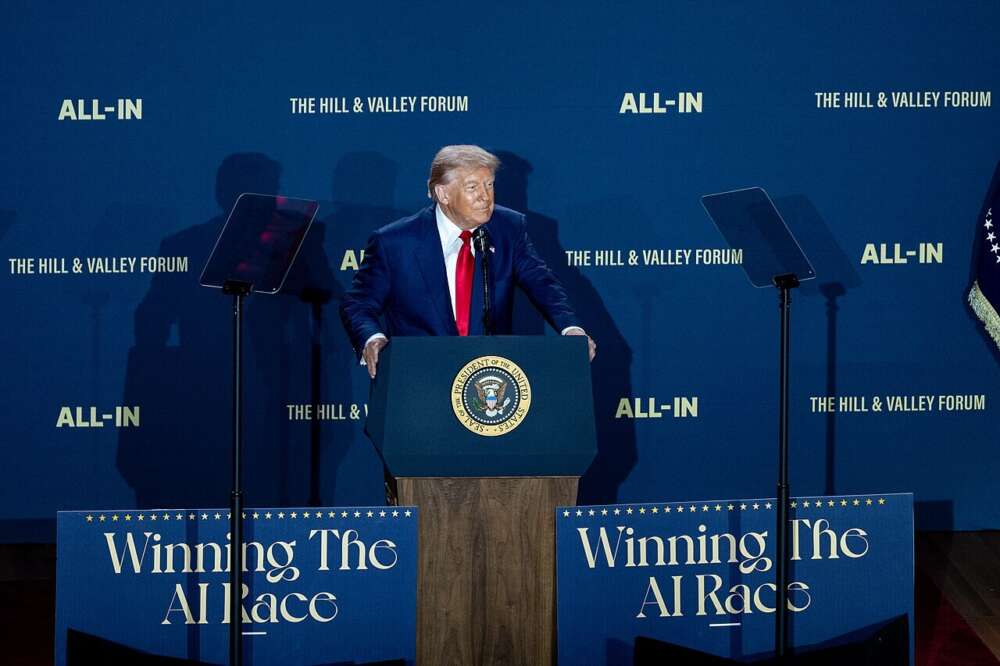
In July 2025, the White House released its AI Action Plan, aptly subtitled “Winning the Race.” It articulates the Trump administration’s vision for America’s place in the global artificial intelligence (AI) landscape. A few sections grabbed most of the headlines: its staunchly anti-regulatory stance, its rejection of (allegedly) “woke AI” and its resolute focus on building out AI infrastructure. One largely overlooked initiative was a new program to facilitate the export of the full American AI technology stack — from AI infrastructure to applications — to the rest of the world to prevent countries from turning to “our rivals.” Of course, this actually only refers to one rival: China. Given the recent release of multiple Chinese open-weight AI models competing near the technological frontier, their widespread adoption across the globe and the launch of the China-led World AI Cooperation Organization, the United States’ AI export push is likely to gain in relevance.
However, a year after it was announced, what is now called the American AI Exports Program (AAEP) is still in its inception phase. From April through June of this year, the International Trade Administration (ITA) within the US Department of Commerce sought proposals from industry consortia offering vertically integrated, off-the-shelf export packages, from chips and data centers to AI models and applications. In July, the agency announced it had received 78 applications, exceeding expectations according to official statements, but far fewer than expected according to former Commerce officials, as reported by Politico. We will likely learn by fall which and how many consortia have been selected for the program. These consortia are in turn eligible for financing support, preferential export licensing and assistance from the US government in securing new deals, whether through direct engagement with foreign governments or introductions to local stakeholders.
Though we do not know what exact shape the program will take, it still warrants attention from European policymakers. The program’s design and success (from a US perspective) will factor into both tech sovereignty efforts in Europe and recent debates about access restrictions for US frontier AI models. The AAEP has the potential to become a significant pillar of how the US government engages other countries on issues related to AI. It currently sits alongside efforts such as Pax Silica, the State Department’s supply chain resilience initiative to which Germany and the EU signed on in June; the Trump administration’s (somewhat erratic) use of export controls on AI chips and, more recently, AI models like Anthropic’s Claude Mythos and Fable; as well as potential restrictions on the use of Chinese open-weight models by US companies, recently debated in Washington.
A Menu of AI (Mostly) Made in America
Essentially, the AAEP seeks to facilitate the creation of an inventory of full-stack AI export packages provided by US-led industry consortia. The call for proposals published by the ITA only covers “pre-set” consortia, though at a later point there could also be calls for “on-demand” consortia in response to specific opportunities. Each pre-set consortium should be able to deliver each layer of the AI stack (as defined by the AAEP):
- AI hardware and infrastructure (e.g., chips, networking, cloud services)
- Data pipelines
- AI models
- Cybersecurity measures
- Applications for different sectors and use cases
In principle, consortia are also expected to demonstrate that at least 51 percent of hardware value is US-made and that AI models come from companies that are majority-owned and controlled by US entities. Furthermore, members of a consortium or implementation partners must not be from, or controlled by, countries of concern, namely China, and no consortium is permitted to use open-weight AI models from countries of concern. This would prevent consortia from integrating Chinese AI models like DeepSeek, Alibaba’s Qwen or Moonshot AI’s Kimi models.
As long as they are not linked to countries of concern, companies from foreign countries can participate in consortia. However, for certain components, they can only be lead suppliers of those components in exceptional cases. On a case-by-case basis, a so-called “national champion enterprise” (NCE) could be granted an exemption to be a consortium’s lead supplier of hardware, infrastructure components or AI models — but only in its home country. Under this arrangement, for example, French AI champion Mistral could become the NCE model provider for a consortium targeting the French market if it partnered with US companies at the hardware, infrastructure and other layers.
The call for proposals remains noticeably vague on two important aspects. First, and surprisingly, it provides little strategic direction on specific target countries or regions to prioritize, though it does emphasize unspecified markets where US companies are competing with providers from countries of concern. Second, the designation of consortia (and of NCE exemptions) by the Department of Commerce will be largely discretionary, without clearly defined criteria or scoring metrics, based on a vague notion of whether consortia serve the national interest. This, at least in theory, opens the door to the type of cronyism that we have now become accustomed to from the Trump administration.
Two Readings of the AAEP
Broadly speaking, there are two competing readings of the AAEP, what it might look like when fully implemented and the underlying rationale for the program. The first reading is that the Trump administration does not yet have a coherent vision of what the program should be. Most likely born out of pressure to respond to the growing capabilities and popularity of Chinese open-weight AI models, the program was meant to somehow ensure that the world builds on American technology. But views within the Trump administration — in particular between and within the Departments of Commerce and State as well as the White House Office of Science and Technology Policy — on how to engage international partners when it comes to AI appear to diverge significantly. Most notably, this includes the sustained strategic tension between US export promotion and export control efforts. So, while the program’s implementation moves forward, its rank on the administration’s list of priorities is not entirely clear.
As mentioned, there are important, unanswered questions about the program’s design, namely what exactly consortia should offer, where they should focus geographically and how this would serve the US’s loosely defined national interest. Commerce appears to be looking to industry for strategic groundwork and direction. Further, as some analysts have argued, it is unclear whether the program meets an actual need from companies along the AI supply chain — companies whose global distribution channels appear to be working largely fine. This could have unintended effects, leading to either industry free-riding on government efforts or the US government claiming new AI deals abroad as political wins when those would have happened even without its involvement.
If responses from potential program participants across the AI stack to a request for comments launched late last year are any indication, the program has broad support, though in many cases it is conditional on certain design choices. However, whether this support was largely performative or has resulted in consequential consortium submissions to the ITA remains an open question.
The second reading, from a European perspective, is more cautious. While the Trump administration is certainly not immune to dysfunction, and while its approach to AI has been capricious on occasion, its ties to the AI industry run deep and its strategic priorities are mostly clear. From a more skeptical perspective, the AAEP could therefore be interpreted as an aggressive instrument of tech diplomacy and trade policy. By pushing the global diffusion of AI made in America, the US government is attempting to further solidify its technological leadership, while selectively leaving the door open to cut in foreign technology providers of importance.
While Pax Silica speaks the language of partnership, the AAEP says “buy American” — a framing issue that some analysts have pointed out to the administration as potentially detrimental to the program’s objectives. If the initiative succeeds in rallying industry around its goals, however, it could — by incentivizing stronger coordination between actors along the AI supply chain — ensure there are off-the-shelf and admittedly superior AI offerings on the table for any country looking to invest in AI. With US government-facilitated financial support, this could come with favorable financing terms. It could also more deeply enmesh national champions in US-dominated supply chains.
The AAEP might also add another bargaining chip for the US in trade and other negotiations, for example by predicating access to export-restricted parts of the AI stack on procuring US-made technology across the whole stack or by promising concessions on other issues should countries invest in US instead of Chinese or domestic AI technology. This would not only undermine widespread ambitions to reduce technological dependencies on the US among many allied nations; it would also boost sales for the many US companies that are deeply invested in the AI infrastructure buildout and feeling increasing investor pressure to generate the revenue to show for it.
Granted, both of these interpretations may paint an exaggerated picture and run the risk of either under- or overrationalizing actions by the Trump administration. The truth is likely a blend of the two. The latter interpretation reflects, at least in parts, the original rationale based on which the AAEP was conceived more than a year ago. The former reflects its more complicated current reality.
What This Means for Europe
European policymakers should resist the urge to assume that this is primarily about Europe. The first and foremost objective of the AAEP is to provide a counterweight to the growing influence of Chinese companies in the global AI ecosystem. We can safely assume that significant parts of this effort will be directed toward large, contestable markets in the Global South in which the Chinese tech industry already has a sizable footprint, like Brazil, Indonesia or Kenya.
Still, it is clear that since the initial announcement of the AAEP, the sense of urgency around the question of digital sovereignty and resilience has increased in Europe and among other longstanding US partners — something that Trump administration officials are following closely and, in some cases, openly criticizing. Further, there is an increasing financial need for leading AI labs to expand their commercial reach around the globe and push into every viable market.
European governments should make no mistake: no matter how one construes the AAEP, the Trump administration is intent on “winning the race” for global AI leadership. This holds true even when accounting for defensive measures like export controls on chips or AI models, such as those recently imposed (and later lifted) on Anthropic’s most advanced models. Even if restrictions on access to the frontier of AI development are in place, the US stands to gain from aggressively exporting unrestricted AI technology. And as long as the capability gap between US AI labs and the rest of the field persists, any US administration is likely to use access to advanced technology as a carrot and stick while simultaneously championing its tech industry abroad.
In any case, the Trump administration will clearly try to convince or coerce countries to not build on Chinese technology, which at least for now is available in the form of more cheaply deployed open-weight models — as the US has done before with regard to 5G and its Clean Network Initiative, albeit with mixed results. And it will seek to solidify the US tech industry’s grip on vital digital infrastructure and AI services.
European policymakers need to clarify their strategic priorities as well as their stance on the crucial trade-offs that Europe is faced with as it navigates both the US’s and China’s increasingly aggressive approaches toward export control and promotion. This is not a task to be tackled by tech, economic or foreign policymakers in isolation. Given the complexities and intertwined nature of the AI stack, this should be a whole-of-government effort. While Europe realistically cannot break loose from all of its dependencies, it will have to shake off or reduce some of them if it wants to limit US leverage instead of being further locked into an ever-expanding array of closed US tech ecosystems.
First, this means deciding which layers of the AI stack to invest in to double down on strengths and reduce dependencies. It also means deciding where to strengthen partnerships and interdependencies with other countries in a similar predicament, and where to accept dependency on dominant players.
Second, European policymakers need to consider whether to prioritize building up and supporting non-US and non-Chinese technology providers. This would enable greater flexibility but potentially require greater investment and, for now, a lag in capabilities. Alternatively, policymakers could secure access to market-leading technology from the US (or China), though at the cost of deepened economic and technological dependency as well as vulnerability to coercion.
Third, policymakers should consider how European players in strong competitive positions could be promoted as consortia members. Last year’s request for information showed some enthusiasm for the AAEP among European companies along the AI infrastructure supply chain (e.g., Nokia, Ericsson and Schneider Electric), in enterprise software (SAP) or industrial applications (Siemens). For these companies, the AAEP could be a lever to facilitate projects around the globe and improve their positions in the market.
A clear-eyed approach to engaging with the AAEP thus requires a firm position on both potential opportunities and threats for Europe, paired with a grounded assessment of Europe’s position along the AI stack today. However, this work goes beyond just the AAEP. How to understand the program within the broader push toward the export and diffusion of US and Chinese AI technology, and how to respond to it, will be the focus of future work on this topic.




.jpg)