The Unlikely Demographic That May Determine Hungary’s 2026 Elections
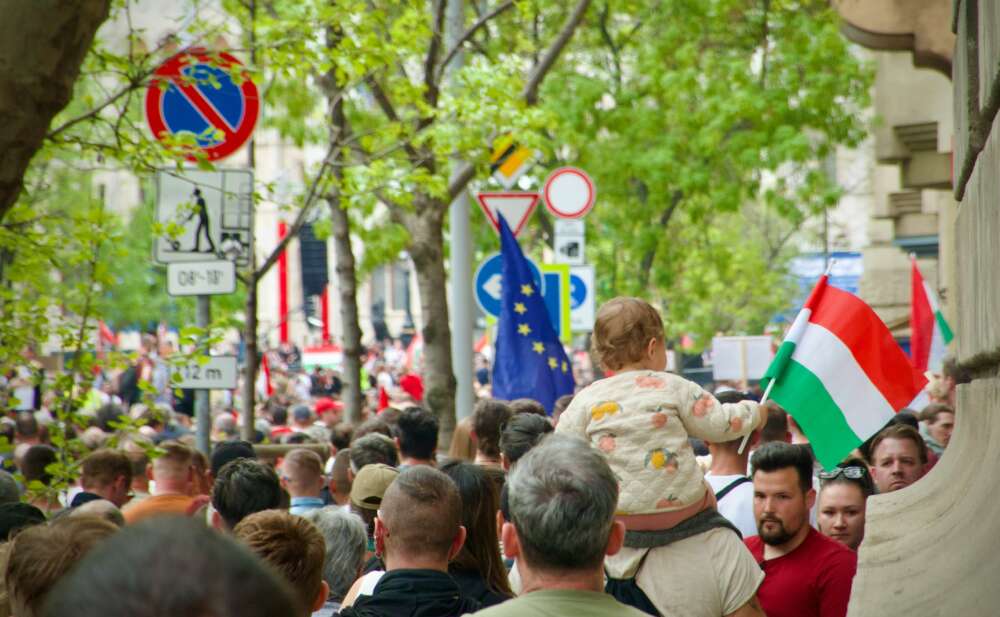
By the time Hungarian Prime Minister Viktor Orbán’s fourth term rolled around, many Hungarians had resorted to a state of bitter resignation regarding their country’s domestic politics. After decades of daily corruption and deception, political disconnection has become muscle memory. But that is slowly starting to change: Hungarian society is re-engaging politically and taking to the streets on a scale not seen in years – and not for the reasons one might expect. Ultimately, it is not the erosion of democratic rights that is causing cracks to show in Fidesz’s so far unchallenged grip on power, but rather the issue of “child protection” – itself one of Fidesz’s favorite dog whistles.
This is a case study of how an unlikely and overlooked demographic – children – may have the political salience to break Fidesz’s political hold. With the 2026 parliamentary elections coming up in April and former Fidesz member Péter Magyar emerging as a serious challenger to the regime, it may even drive a transformative electoral outcome. This piece will delve into how child protection has become the rallying cry of a newly politicized front of Hungarians and what lessons European policymakers can draw from this case study to further promote a democratic agenda in Hungary.
‘The Child’ as a Conceptual Rallying Cry
In 2022, Hungary saw the first wave of anti-government protests conceptually rallying around the rights and protection of children. What had started as a teachers’ protest for higher wages in Budapest (brutally suppressed, with many protesting educators getting fired after attending the demonstration), quickly morphed into a much broader movement, marching not only for the deeply undervalued teachers but also for the children who were being deprived of an adequate education due to the systematic shortcomings the original teachers’ protest criticized. Risking retribution, students themselves joined the growing ranks of protesters (which reached 80,000 people at its peak); many took on a primary organizing role within the movement, thereby establishing a new protest infrastructure that will carry future generations of protests.
Two years later, the “pedophile clemency scandal” shook the country in February of 2024. In what became known as the largest scandal of the Orbán era, legal documents were leaked that uncovered how the Hungarian President, Katalin Novák, had pardoned a former deputy director of an orphanage who had been convicted for coercing children to withdraw their testimonies of sexual abuse against the director of the same institution. Although the regime attempted to use its usual media deflection strategy of denial and suppression, it drastically underestimated the force of the scandal. This miscalculation came with an immense political cost: over 50,000 demonstrators took to the streets for three months to protest, demanding Hungary’s child protection system be reformed. To tame the outrage, Fidesz was forced to fire two of its high-ranking politicians who approved the parson: President Novák and Judit Varga, the Minister of Justice. Estimates show that Fidesz lost between 150−200,000 voters in the immediate aftermath of the scandal. The scandal and its aftermath also caused a political ripple effect, which will have long-lasting consequences: Péter Magyar stepped out of the party, founded a new party, Tisza, and is rapidly becoming the most significant challenger to the regime Hungary has seen in years.
In September 2025, the contours of yet another major scandal started to form: incriminating videos filmed in a Budapest-based juvenile detention center started to surface, showing the center’s director dragging a boy across a table and kicking him in the head. Similar to the clemency scandal, this proved to be a Pandora’s box; each week, new details arose highlighting the many webs of corruption and police negligence that enabled systemic child abuse to go on uninterrupted for allegedly three decades. Again, Fidesz’s textbook deflection and trivialization strategies were unable to contain media representations of the story, often only adding fuel to the fire. When asked to clarify recent allegations of forced labor and human trafficking against the director of the center, a media personality from the Fidesz network commented that if the director was indeed involved in the prostitution of girls, “the girls earned some money too, so everyone got a good deal.” This usual stream of rhetoric coming from the government and its affiliates seems to have stopped resonating outside its own voter base.
Recent polls show that the scandal is becoming a growing concern among undecided voters – a crucial demographic, given what is expected to be a very tight electoral race between Fidesz and Tisza in April. While the two major parties’ voters reflect predictable trends in their responses to the scandal, undecided voters seem to lean towards Fidesz’s culpability, with only 8 percent thinking the governments not at fault, and 40 percent believing that Orbán should resign immediately. Despite its unencumbered media control, Fidesz can’t seem to convince the public that this story, too, is just a liberal hoax.
How Orbán’s Spin Doctors Lost Their Touch
Fidesz is no stranger to politics centering children, at least rhetorically. Many of its largest propaganda campaigns have revolved around the need to protect Hungary’s children – from ‘woke’ propaganda, LGBTQI+ ‘ideology,’ and from attacks on the Christian atomic family model. The recent children’s rights scandals have been so affecting, because they have blown the cover off of Fidesz’s internal hypocrisy (and its webs of corruption): their supposed pro-children stance has proven to be incoherent and an empty shell. What is collapsing is not just the relationship between citizens and the government, but the broader Fidesz-affiliated social infrastructure and its beneficiaries, who have assumed well-paying public roles in exchange for their loyalty to the regime.
Another reason why this issue in particular is so potent: the topic of children’s protection is just apolitical enough to be abstracted away from party agendas and media propaganda. This proves that the challenge in mobilizing Hungary’s disengaged general population was never finding an issue that was politically salient enough; it was finding one that seemed apolitical enough.
Simply put, it was a matter of locating the bare minimum political consensus of dignity and fairness – one that Fidesz’s own child-protection propaganda has continuously exploited. Although on the surface these scandals may not be about economic or constitutional grievances, they weave together children’s rights with fundamental democratic failures, from rule-of-law erosion to human rights violations.
And they do so in a way that makes voters see the structural ties of the Fidesz regime: while rule of law issues can seem convoluted and wrapped in “Brusselite” jargon, witnessing that teachers can be fired from their jobs for attending a protest, that criminals can run children’s institutions for decades with impunity, that abusers’ accomplices can be granted presidential pardons because they have favorable ties to powerful politicians, illustrates the corruption underlying these systems. This structural abuse of power has become emblematic of Hungary under Fidesz rule and has become an entry point to voice disillusionment.
The Protests’ Afterlife
It has become quite clear that children’s protection is a consistent trigger point in Hungarian politics; the three scandals mentioned above managed to garner support for the longest sustained protests in Hungary in the last five years. Although we are yet to see how enduring the juvenile detention center scandal’s effect will be, it has already had a catastrophic impact on Fidesz’s chances this upcoming election.
Looking at the bigger picture, what the democratic momentum caused by these scandals can show us is that children’s safety is a resonant point in Hungarian society – an important learning when thinking about how to breathe life into debates about fairness, democratic values and state responsibility. This lesson can also be applied to the level of EU advocacy: when EU democracy promotion tries to pressure Hungary by using the traditionally visible, problematized issues revolving around identity politics (chiefly, LGBTQI+ rights) or foreign policy issues, this often falls flat, however well-intentioned it may be. Although they remain crucial issue areas, they are not the most salient from a strategic mobilization perspective, given Hungarian voters’ political profile.
Rather, as demonstrated in this piece, it may be worthwhile to reorient some attention to an often-overlooked force with underestimated potential on local politics: children’s protection.
If the EU seeks to establish a meaningful lifeline to civil society in Hungary, it needs to better understand which issue areas function as effective pressure points within Hungarian society. These pressure points are more often than not found at the community level, where people’s most urgent concerns lie — starting with the safety and future of children.