United in Shared Vulnerabilities
Why Germany, Japan and South Korea Must Stand Together
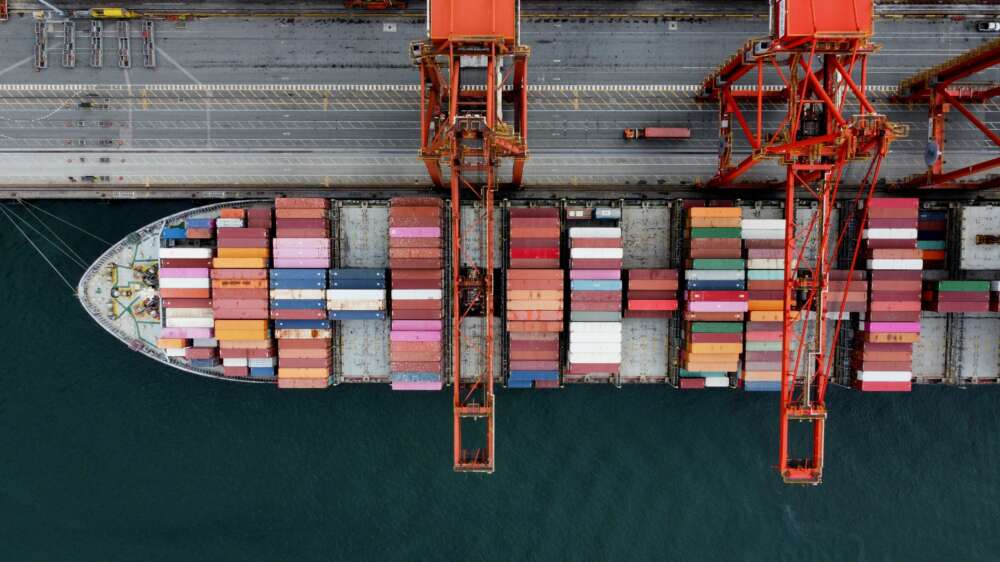
The boundaries between economic policy, technological competition and hard security are becoming increasingly blurred to the point of dissolving entirely. For Germany, Japan and South Korea – three open, export-oriented democracies whose prosperity depends on stable supply chains and a functioning international order – this transformation is not an abstract geopolitical trend but an immediate governing challenge.
Last week (on June 8, 2026), Global Public Policy Institute (GPPi) and Heinrich Böll Stiftung brought together Sara Nanni (German Member of Parliament, Alliance 90/The Greens), Hitoshi Suzuki (Senior Research Fellow, Institute of Geoeconomics) and Eunjung Lim (Professor of International Studies, Kongju National University) in Berlin to ask what a deeper partnership between Germany, Japan and South Korea could look like. The central question animating the discussion (moderated by GPPi’s Joel Sandhu): Can three countries with different strategic cultures, distinct threat landscapes and complicated shared histories translate converging threat perceptions into practical, durable cooperation? And what is genuinely at stake if they fail?
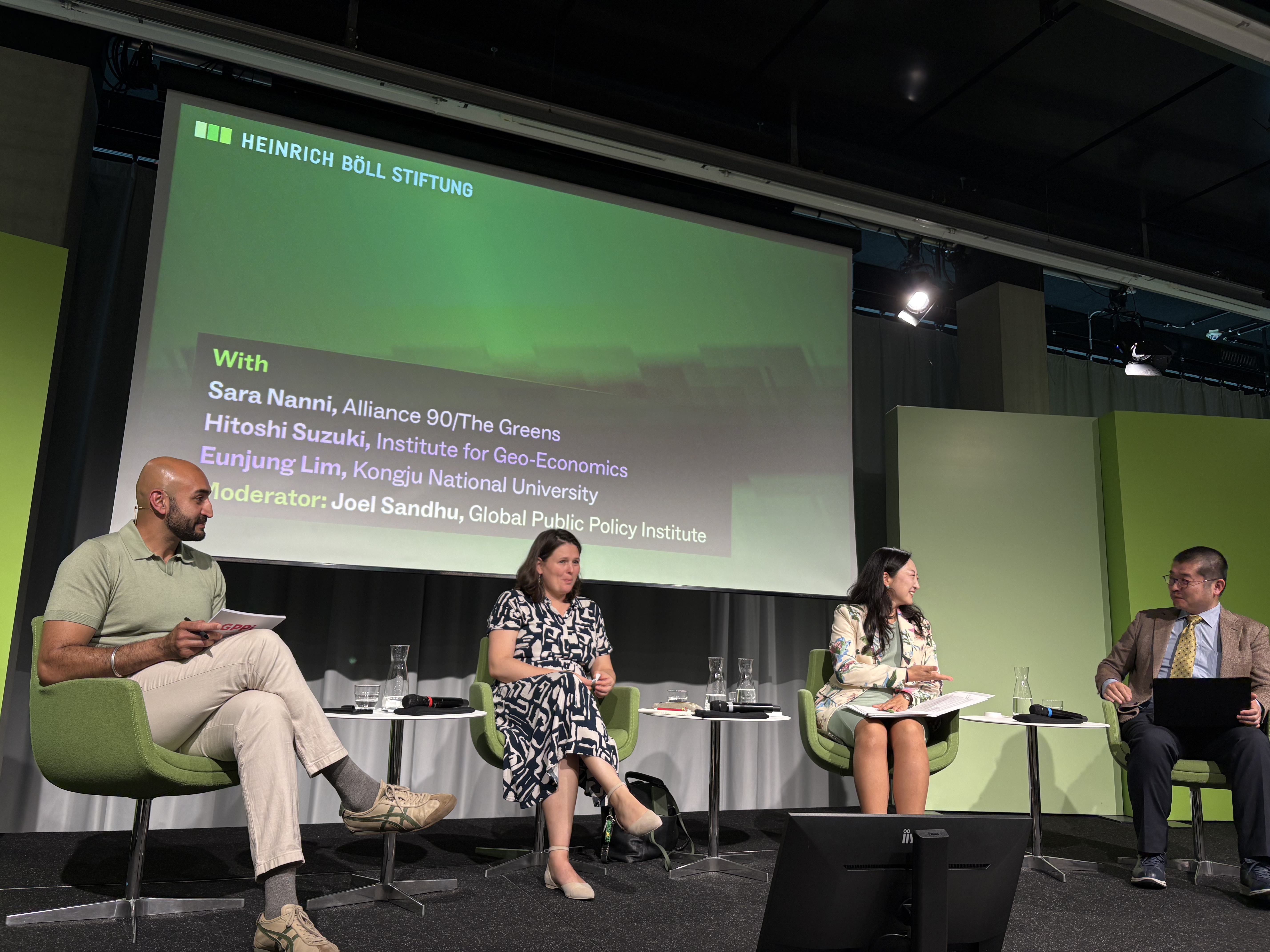
Credit: Photo taken by GPPi’s Sophie Weis.
Between Beijing and Washington
For all three countries, the strategic picture is shaped by a double dependency on both the United States (US) and China – a dependency which is becoming increasingly difficult to manage. They rely on the US for security and on China for trade. These dependencies are quickly becoming less reliable: Washington’s position vis-à-vis its allies has grown less predictable, and as Suzuki noted, Japan and South Korea find themselves in an even more exposed position than their European counterparts. Unlike NATO members, they have no collective defense framework to fall back on. Meanwhile, China has demonstrated repeatedly that economic interdependence can be weaponized. As Suzuki put it, economic security simply means “security plus economy.” The fusion of the two fields is now irreversible: peacetime economic logic and wartime readiness can no longer be separated.
The climate dimension heightens the stakes further. The energy transition depends on battery supply chains overwhelmingly concentrated in Chinese hands, from raw material extraction to processing. South Korea holds significant battery manufacturing capacity, yet remains critically exposed with regard to critical minerals. The panel framed Germany’s deep industrial entanglement with China as both a vulnerability and a cautionary tale for European partners more broadly. The honest assessment from Suzuki was that even Tokyo, which began diversifying earlier, has not achieved as much as it might claim. Rare earth dependency remains substantial, and the pressure is intensifying as China recently began restricting exports to target the Japanese defense industry.
The discussion resisted easy answers. Panelists mentioned the diversification of energy sources, supply chains and technological partnerships as possible ways out of this bind, but they also acknowledged the challenges that come with each of these options. From a South Korean perspective, Lim offered a more concrete horizon: sodium-ion battery technology, which relies on more globally abundant materials, could reduce Chinese mineral dependency over time. Lim argued that resource partnerships with countries such as Canada and Australia would be equally important. A structural tension ran through the whole section: the same competitive pressure that drives companies to remain present in the Chinese market also deepens the dependency that governments are trying to reduce.
Democratic Resilience and Hybrid Threats
If economic security provided the strategic framework for the discussion, democratic resilience emerged as its most consequential concern. The main vulnerability Nanni identified was not a technical one, but rather cognitive. Autocracies do not merely seek to influence governments; they seek to shape the perceptions, emotions and political instincts of democratic societies themselves. Rather than creating divisions from scratch, they identify existing frustrations and amplify them, deepening polarization and weakening trust in institutions. In essence, they are rage-baiting citizens of democratic societies. The objective is not necessarily to persuade citizens of a particular worldview, but to cultivate anger, cynicism and distrust. As Nanni put it, there is a global fight over the brains of liberal democracies. Because democratic systems ultimately depend on public opinion, influencing how citizens think, feel and interpret events becomes a form of strategic power. An electorate that is angry, fragmented and instinctively anti-establishment becomes easier to manipulate and harder to govern. As Nanni emphasized, autocracies know exactly what is going on and have a plan for the international order. And democracies, increasingly turned inward, are handing them the space to execute it.
The common thread was that the very openness that defines liberal democracies is the space that its adversaries seek to exploit. All three panelists were firm that the response must not reproduce the pathology it is meant to cure. Expanding surveillance, restricting civil liberties or allowing emergency logic to erode free expression would be a form of self-defeat. Fact-checking infrastructure, media literacy and robust oversight of foreign acquisitions in strategic sectors all emerged as necessary investments. The most concrete proposal the discussion produced was also the most transferable. First, governments should share specific, documented cases of disinformation and their effects across the three countries, including with partners such as Australia. And second, they should make the pattern visible to domestic audiences who find it hard to believe their own information environment has been deliberately targeted.
Cooperation Between Middle Powers
Framing these three countries as “middle powers” conceals as much as it reveals. By themselves, Germany, Japan and South Korea are indeed medium-sized, but together they can form a powerful counterforce to the US and China. After all, they are technologically advanced states, deeply embedded in global trade and positioned in regions where the architecture of the international order is actively being contested. The question is not whether they are powerful or not but whether they have the coherence, resources and political will to act on their collective power.
The participants highlighted several structural deficits with the potential to weaken their cooperation: the lack of relevant language capacity in the German administration, for example, limits the depth of partnership that can be achieved. Political incoherence between ministries, with defense and economic affairs often pulling in different directions on bilateral cooperation, also undermines Germany’s credibility vis-à-vis its partners.
The discussion also challenged the notion that European and Indo-Pacific security can be treated as separate theaters. Lim noted that many South Koreans initially viewed Russia’s invasion of Ukraine as a distant conflict, only to realize how directly it affected Northeast Asia through North Korea’s growing involvement and its ability to draw military and technological lessons from the war. Suzuki pushed this argument further, suggesting that Ukraine and Taiwan should not be viewed in isolation from one another. The broader point was that developments in one region increasingly shape calculations in the other, making security interdependence a defining feature of the current international environment.
The overarching case for deepening the partnership rested on two arguments. First, middle powers are defined not only by size but by their behavior. As Lim argued, countries such as Germany, Japan and South Korea retain the ability to influence international outcomes through coalition-building, norm-setting and sustained cooperation. Their significance lies less in their individual weight than in their capacity to act collectively. Second, as Suzuki noted, neither Japan nor South Korea possesses sufficient economic leverage to shape China’s behavior on its own. Europe, by contrast, remains a critical export market for China, with Germany occupying a particularly important position within it. That leverage is most effective when exercised in coordination rather than individually.
The panel offered a clear answer to the question with which it began. Differences in strategic culture, geography and domestic politics are real, but they are increasingly outweighed by shared vulnerabilities and interests. The task ahead: build the political and institutional capacity required to deepen and sustain the all-too-necessary cooperation between Germany, Japan and South Korea.