A Little Goes a Long Way: The Case for Saving German Humanitarian Aid
Humanitarian aid is in crisis. Globally, nearly 300 million people are in need of humanitarian assistance – but major donors are slashing their budgets. The consequence: only 40 percent of those in need receive aid. What emerges is nothing less than a global “triage,” where humanitarian aid is only able to address the most pressing needs. And while the German public has fixed its eyes on the US, outraged over the Trump administration’s humanitarian cuts, Germany is taking a similar path. The German government is planning to slash humanitarian aid by more than half in 2025 – 2026 (as compared to the 2024 budget). Given the country’s status as the world’s second-largest donor in recent years, Germany’s cuts will have a decisive effect on the humanitarian system’s funding crisis. Despite these stakes, outcry from the German public has been minimal – but why?
When Cuts Spark Minimal Opposition
As a recent New York Times investigation shows, USAID got dismantled with virtually no resistance. Although the public is not fundamentally opposed to foreign aid, opponents successfully entrenched the myth of humanitarian aid as waste (money squandered on absurd projects) in people’s minds.
Germany should take note. Here too, roughly three out of four people support humanitarian assistance – and yet, there is little protest against the cuts. The debate is less about whether Germany should provide aid and more about how much: in times of perceived budget scarcity, attention turns inward, and defense spending appears more urgent. And as in the US, it is often the populist criticism of aid spending that makes headlines, not the success stories. One need only recall the persistent myth about millions of taxpayer euros wasted on Peruvian bike paths – a conservative spin, far from reality, that made German headlines in 2024 and resurfaced recently. This negativity bias shapes the broader image of foreign aid, imprinting upon the taxpaying public a distorted – and incorrect – cost-benefit calculation.
Achieving a Lot with Little
In reality, humanitarian assistance achieves a lot with (very) little. The figures for Germany’s humanitarian aid budget underscore just how modest aid shares really are. For both 2025 and 2026, only around one billion euros are allocated – a mere 0.2 percent of total government spending. Even in the record year of 2022, this share reached a record 0.7 percent.
There is ample evidence that this spending is worthwhile; countless studies and evaluations demonstrate how much impact can be achieved with relatively modest resources. A recently published impact evaluation in the scientific journal The Lancet estimates that funding from the United States between 2001 and 2021 prevented more than 90 million deaths – a number higher than Germany’s current population count.
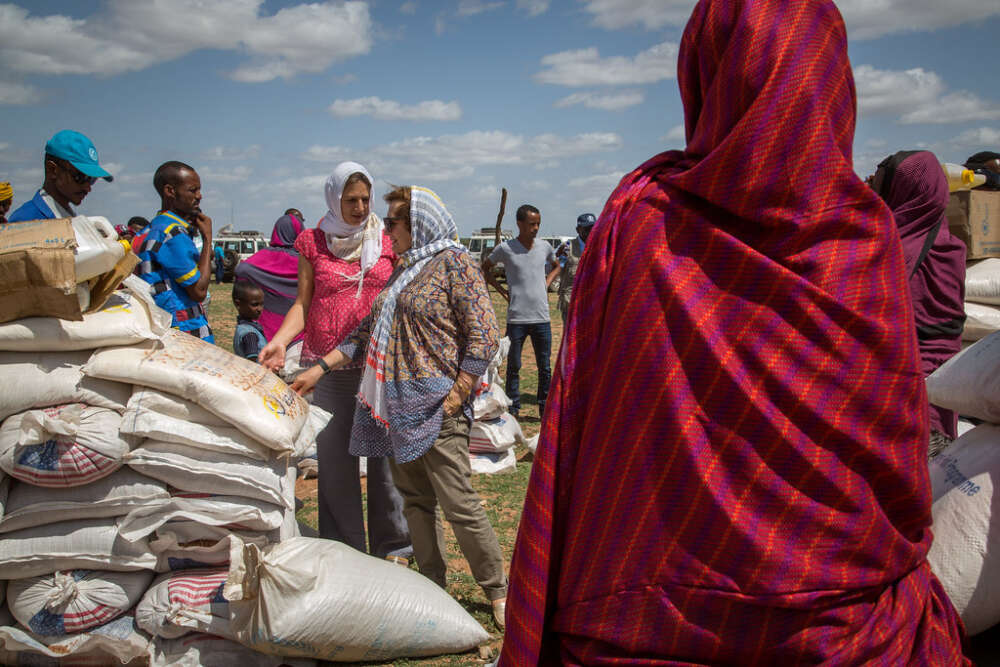
Or take a 2025 evaluation of the humanitarian system’s response to the looming famine in Somalia in 2022 and 2023: humanitarian intervention saved tens (if not hundreds) of thousands of lives, and 96 percent of children treated for malnutrition recovered thanks to the assistance provided. The cost of these interventions for Germany? Around 230 million euros, which amounts to the sum the German government spends every four hours.
During Ethiopia’s 2015 – 2018 drought, three-quarters of malnourished children recovered, thanks to international support provided. Again, the cost for Germany was negligible. In 2016, for example, Germany spent 86 million euros (or what the government spends in 2.5 hours).
Any way you slice it, in humanitarian aid, a little goes a long way.
Three Recommendations for Those Who Are Convinced:
These examples from the US and Germany show that public support for humanitarian aid cannot be taken for granted. It takes more than expert opinions to prevent Germany from further shirking away from its global role in humanitarian assistance.
- Debunk the myth of wastefulness, communicate impact. Polls have long shown that one objective resonates most strongly among the German population: “Having great impact with little means.” With significantly less than one percent of the federal budget, Germany saves tens of thousands of lives. This impact narrative deserves to be highlighted more strongly alongside other arguments – appeals to humanity and global solidarity, or the more self-serving strategic argument that advocates creating prospects for displaced people in regions closer to their home countries. Humanitarian actors may not let evaluation evidence gather dust at the back of the proverbial closet, and the media should feature more success stories. At the same time, it is up to us to carry these positive examples of humanitarian aid forward – whether that be at the family dinner table or in conversations with friends.
- An honest and accessible dialogue on sector reforms (without resorting to populism). The humanitarian system is well aware of its weaknesses – even without facing the added pressure of a funding crisis. The sector knows reforms are urgently needed; in many places, they are already underway. (Here too, the lessons learned from large-scale aid evaluations will prove invaluable.) Debates on efficiency and how to best reform the humanitarian system take place almost exclusively within a bubble of experts. What is needed are more open conversations between experts, policymakers and citizens.
- Turn quiet support into action. Those of us who are convinced of the impact and importance of humanitarian aid should consider putting our money where our mouth is – whether that be through private donations, personal engagement or by taking a clear political stance. Above all, both members of parliament and citizens must hold the German government to the same standards as the Trump administration. Germany is a major contributor to the global humanitarian funding crisis – only second to the US – and should be held accountable accordingly.
A version of this piece was originally published in German by taz on September 8, 2025.