Damian Lilly on Cost Efficiency
Interview Series: Aid, Rebuilt
This interview is part of a larger conversation series with leading humanitarian thinkers on how to reshape and reform the aid system in turbulent times. This month, we’re talking to Damian Lilly, an independent humanitarian consultant based in Mozambique.
If you could rebuild the aid system, what is the one main thing you would change?
One thing that should be more of a central discussion point for rebuilding the aid system is cost efficiency. Aid cuts have put the spotlight on whether scarce humanitarian resources are being used in the most optimal way. Cost efficiency was not such an issue when resources were more plentiful. But with funding falling by a third since peak aid in 2022, the use of every humanitarian dollar now needs to be extremely well justified.
Many humanitarians probably already feel that, with the brutal downsizing of the sector, financial spreadsheets are already dominating how operational decisions are being made. The truth, though, is we still can not say that the humanitarian system is designed in the best way to save the most lives with the least amount of money.
You mention financial considerations already dominating operational decisions. Are there specific funding models that are more efficient than others?
The landmark agreement between the United States (US) and the United Nations (UN) Office for the Coordination of Humanitarian Affairs (OCHA) announced earlier this year, which outsourced grant management to OCHA pooled funds, has massively reduced the US government’s administrative costs of managing hundreds of projects across multiple contexts and organizations. This is exactly the kind of flexible funding aid agencies have been demanding for years.
But in reality, most of the deal’s initial 2 billion USD contribution went to UN agencies. In June, a further 1 billion USD of direct US funding to World Food Programme (WFP) and the United Nations International Children’s Emergency Fund (UNICEF) was announced. It begs the question: Why not give the money directly to UN agencies, rather than indirectly through OCHA? Would not that be more efficient?
The reason for providing the US contribution through pooled funds is that we are told that they are a more effective way of allocating humanitarian funding. Tom Fletcher, the Emergency Relief Coordinator, has expressed his desire that 50 percent of humanitarian resources be channeled through pooled funds. However, notwithstanding the US change of policy on supporting pooled funds, there is no evidence that other donors are increasing their contribution to these funding mechanisms, despite the purported benefits.
The US-OCHA agreement has shaken up how donors fund humanitarian aid. Some governments already use the US’s multilateral approach, while others execute a more direct grant management role, including at the field level. We simply don not know which model is more efficient, let alone whether donors can agree to this and change their aid structures accordingly to be more efficient.
A major barrier to getting aid efficiently to where it is most needed is the high number of intermediaries between the source of humanitarian funding and the eventual recipients of aid. It is not uncommon for a donor government to contribute funding to a pooled fund which then passes the money to a UN agency, only for them to contract an international non-governmental organization (NGO) who in turn sub-contracts a local NGO before the assistance is finally delivered to its intended beneficiary. With each organization in the chain taking its cut in overheads, this arrangement makes the humanitarian sector extremely inefficient and wasteful. Like a Russian doll, once you peel away the layers, there is not much left at the end. It is little wonder that organizations like Give Directly are marketing themselves on their ability to more directly get assistance to where it is needed.
Currently, there is no explicit limitation on how many sub-grantees aid agencies may use, nor any system-wide effort to manage this problem. This needs to change. If we want the humanitarian system to be more efficient, the number of intermediaries in the humanitarian system should be reduced.
Beyond the different funding models, does the humanitarian system ensure that the cheapest aid organizations are used by donors to deliver most aid?
Those organizations that are able to provide aid at the lowest cost should be the ones to receive most direct funding. There has been a push for greater ‘complementarity’ so that different humanitarian actors contribute according to their comparative advantages, but this is not yet a reality – and ‘efficiency’ is being used as an excuse to concentrate resources. UN agencies and international NGOs still take the lion’s share of humanitarian funding, even when they are often not the ones actually providing the assistance.
A central pillar of current humanitarian reforms is to increase local actors’ access to funding with the goal of 70 percent of pooled funding going to them. Not only is it more fair for funding to go to those organizations actually doing the work, but it’s actually the most cost-efficient route, too. According to recent research, local and national NGOs are 32 percent more cost efficient when providing assistance than international agencies. This represents major untapped potential annual savings of up to 4.3 billion USD. But currently the trend is for less humanitarian funding going to local actors, not more. In 2025, 45 percent of pooled funding went to local actors; this year that figure has dropped to 18 percent. Overall, local actors receive just 9.5 percent of humanitarian funding. This shows that the humanitarian system is neither committed to shifting power nor providing assistance in the cheapest possible way.
Are aid organizations making cost-efficient program choices at the operational level?
Humanitarian assistance must be targeted where there is the greatest risk to lives lost rather than driven by cost alone. That is why there has been a humanitarian scale-up for a relatively costly response to the Ebola outbreak in the Democratic Republic Congo (DRC) because of the clear dangers of the disease, even when more people die of malaria in the country and it is cheaper to treat them. But this does not mean cost efficiency should not be a consideration in humanitarian programming.
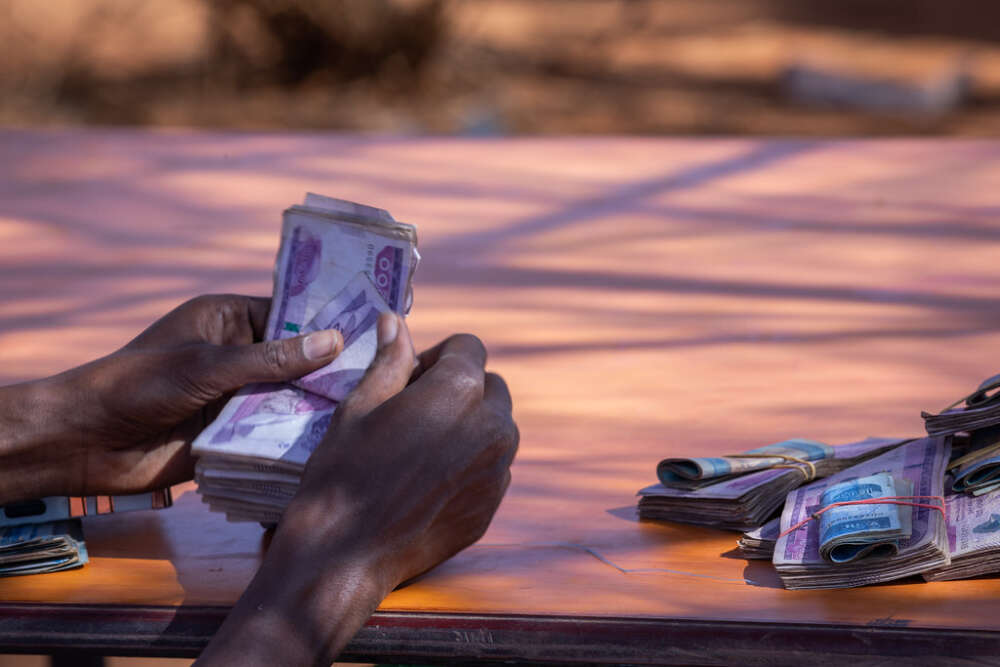
The most obvious example where cost is a key consideration is cash assistance. Not only is it the kind of assistance crisis-affected populations say they prefer, but it’s also cheaper to provide. A recent study found that cash assistance is 37.5 percent more efficient than food aid, which means that between 1.1 and 3.3 billion USD in humanitarian assistance could be used more efficiently each year – enough to reach up to 60 million more people in crisis. Similarly, every dollar invested in ‘anticipatory action’ yields up to 7 dollars in avoided losses and added benefits. Despite this clear evidence of the benefits of acting before crises occur, this type of humanitarian action still only accounts for less than 1 percent of overall humanitarian assistance.
It seems that only certain forms of humanitarian aid – in particular, the ones trying to get prioritized, like cash assistance and anticipatory action – are promoting their potential efficiency gains. You do not hear other sectors justified in quite the same terms. Are there some health interventions that are more efficient than others? Could certain shelter options be cheaper than others? There are examples of such claims buried in appeal documents, but it is not a mainstream issue.
We are, though, seeing some signs that parts of the humanitarian system are taking cost efficiency more seriously. Some agencies have developed cost-analysis tools to estimate the cost efficiency of programs and identify impactful, high-quality interventions that reach more people per dollar. The International Rescue Committee (IRC) established a cost-effectiveness team in 2015, whose cost-analysis approach has led to 28 million USD in cost gains of the 86 million USD of programs to which it was applied – a 32 percent efficiency improvement. Value for money is a requirement of some donors. But these approaches are simply not widespread enough across the humanitarian sector. Justification of the unit costs for different sector interventions, for example, is still not an explicit part of the humanitarian appeal planning process, which would be a starting point for taking the issue more seriously.
What does all this mean for humanitarians? What kind of approach should they have regarding cost efficiency?
Humanitarians do not all need to turn into accountants. But there is a clear imperative to do ‘more with less,’ given rising humanitarian needs, declining resources and diminished trust in humanitarian aid. For this to work, we need to have an honest discussion about cost efficiency and accountability, so that humanitarian money is guaranteed to be used in the best way possible. As an author of the recent Lancet Commission on humanitarian health reform remarked, “the humanitarian sector is the only industry where, if your performance is very bad, we keep funding you.”
According to the 2026 Global Humanitarian Overview, 23 billion USD is needed to save 87 million lives in humanitarian crises this year. But the truth is there is no strong evidence behind this claim. We cannot say with confidence how many lives humanitarian aid saves each year, let alone how much it costs for each life to be saved. Why is that not yet possible? Modern health systems are able to estimate this – the humanitarian sector should aspire to do the same.
Cost efficiency is clearly part of the humanitarian reform agenda, but the issue needs to be taken far more seriously. The first step is to demand great transparency of costs in the humanitarian sector. There should be a system-wide standard for measuring value for money built into all projects and appeal documents. Cost-benefit analysis should be made an integral part of humanitarian planning. Aid agencies should not shy away from, but rather be held to greater account for making operational decisions based on efficiency. This issue should not just be an afterthought, but a central pillar of improving the humanitarian system, even if it is an uncomfortable discussion at times.
For those who would like to engage more deeply with your “one thing,” what reading would you recommend?
In my view, there has not been enough research on cost efficiency in humanitarian action. The Cash and Voucher Assistance Learning Partnership (CALP) recent report Show Me the Money: Efficiency and Effectiveness in Humanitarian Response is the kind of study that we need more of but in other sectors and programme interventions as well. If you are interested in the economics of humanitarian aid, then Gilles Carbonnier’s Humanitarian Economics: War, Disaster and the Global Aid Market and Monika Krause’s The Good Project. Humanitarian Relief NGOs and the Fragmentation of Reason are a good introduction.
Damian Lilly is an independent consultant based in Mozambique who previously worked with the UN as well as a number of NGOs, and writes on a range of topics related to humanitarian reform.